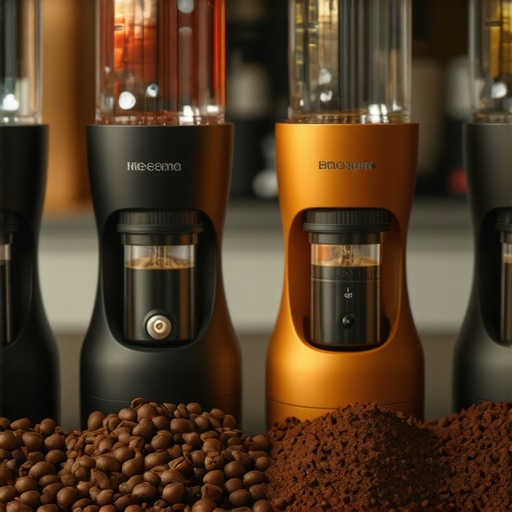
Have you ever pulled a shot of espresso only to find it tasting flat, bitter, or just inconsistent? I’ve been there. One morning, after a frustrating session of adjusting my grinder, I realized that the real culprit wasn’t my beans or machine but my grinder’s inability to produce a uniform grind. That lightbulb moment hit hard — grind consistency isn’t just a detail; it’s the foundation of great coffee. If you’ve ever felt the sting of uneven grounds ruining your brew, you’re not alone. The good news? Today, I’m here to help you cut through the noise and find the perfect grinder for your needs, so you can finally enjoy that pristine, balanced cup every single time.
Why Consistent Grinding Matters More Than You Think
Imagine waking up to the aroma of freshly brewed coffee, only to sip and find it lacking that punch or clarity you crave. That’s often a sign of inconsistent grind sizes. When your grinder produces uneven particles, it leads to over-extraction and under-extraction, which messes with flavor, aroma, and overall quality. According to a study by the Specialty Coffee Association, grind uniformity directly impacts extraction efficiency, making or breaking your brew’s profile (source). It’s like trying to paint a masterpiece with mismatched brushes — you’ll never get that smooth, even finish. That’s why investing in a high-quality burr grinder designed for grind consistency can transform your coffee experience from average to exceptional. If you’ve faced the disappointment of inconsistent grounds, I want you to know that the solution is within reach. The secret lies in understanding what makes a grinder precise and how to select the right one for your brewing style.
Is All the Hype Around Grind Consistency Justified?
Early in my coffee journey, I made a rookie mistake: I thought all grinders were created equal. I bought a cheap blade grinder, thinking it would do the job. Spoiler: it didn’t. My shots were uneven, and my flavor profile suffered. It wasn’t until I upgraded to a quality burr grinder that I truly understood the difference. The truth is, not all grinders deliver the same level of grind consistency, and skimping on quality can cost you in the long run. If you’re serious about brewing great coffee, this is one area where investing wisely pays off. For a curated list of top picks, check out my detailed guide on the best coffee burr grinders for perfect grounds. But first, let’s explore what makes a grinder excel in this crucial aspect and how you can spot the right model for your home setup.
Dial in Your Grind Size with Precision
Start by adjusting your grinder to a fine setting suitable for espresso. A good rule of thumb is to set your grinder so that the coffee grounds are slightly finer than sand. When I first tried this, I took notes of the grind size and pulled a shot. The first was too bitter, indicating over-extraction, but after dialing it slightly coarser, the shot improved dramatically. Use consistent adjustments and keep detailed notes to replicate successful settings. For more detailed guidance, visit this resource.
Use a Burr Grinder for Uniformity
Switch from blade to burr grinders—burrs crush beans uniformly, unlike blades that chop unevenly. I upgraded my grinder and immediately noticed a difference in shot consistency. Flat burrs tend to produce more uniform grounds than conical ones, which can help with grind stability. Regularly clean your burrs to prevent build-up that can cause uneven grinding. If you’re unsure which model to choose, check out top burr grinders.
Set and Maintain Consistent Dose
Use a scale to measure your coffee dose precisely—typically 18-20 grams for espresso. I started weighing each dose and noticed my shots became more consistent. Consider a single-dose grinder, which allows you to grind only what you need, reducing clumping and stale grounds. This small change resulted in more even extraction. For detailed tips, explore single-dose techniques.
Adjust and Calibrate Regularly
Grinders can drift in settings over time. I recommend checking your grind size every few shots and recalibrating as needed. Using a timer or notes can help track adjustments. When I noticed my shots were becoming uneven, I recalibrated by turning the grind dial a tiny bit and tested again. Repeat this process until shots are consistently balanced. For advanced calibration methods, see calibration tips.
Consistent Tamp and Extraction Time
Even with perfect grind size, inconsistent tamping can ruin your shot. Use a tamper to apply even pressure—about 30 pounds—and ensure the coffee bed is level. I used a scale to practice applying consistent pressure and found that it improved shot uniformity. Also, aim for a shot time of around 25-30 seconds. Practice makes perfect, and maintaining consistency here is key for reliable results. For more insights, visit tamping and extraction.
Keep Your Equipment in Top Shape
Regular cleaning prevents oil and coffee residue from affecting grind quality. I clean my burrs weekly using a brush and grinder cleaning tablets. This maintenance ensures that the grinder’s performance remains stable and the grind size stays consistent. A well-maintained grinder reduces the need for frequent recalibrations and keeps your brews tasting their best. For detailed cleaning routines, check out cleaning tips.
Practice and Fine-Tune
Consistency is a skill that improves with practice. Keep detailed logs of your grind settings, dose, tamp pressure, and shot times. Over time, you’ll develop a rhythm and intuition for your perfect grind. When I started tracking my variables, I noticed patterns that helped me fine-tune my process and achieve near-perfect shots every time. Remember, small adjustments lead to big improvements. For more advanced techniques, visit advanced grind mastery.
Many coffee enthusiasts believe that choosing a high-quality burr grinder or a precise espresso grinder automatically guarantees perfect results. However, even seasoned baristas often fall prey to subtle misconceptions that can sabotage their brewing process. One prevalent mistake is assuming that grind size alone determines shot quality. In reality, factors like grinder calibration, burr wear, and consistency over time play critical roles in achieving optimal extraction. For example, a study by the Specialty Coffee Association highlights that minor deviations in grind uniformity can significantly impact flavor, even if the initial settings seem correct (source).
Another often-overlooked nuance is the importance of single-dose grinding. Many users rely on bulk grinding, which can lead to uneven particle distribution and stale grounds due to oxidation. Single-dose grinders help maintain freshness and ensure consistent particle size, but only if used correctly. Regular calibration and cleaning are essential, as burrs can wear down, causing a decline in grind uniformity. Over time, this wear can create a false sense of confidence, leading to inconsistent shots that seem perfect one day and flat the next. Keep in mind that even the best grinders need periodic maintenance; otherwise, you risk falling into the trap of relying solely on initial settings without adjustments. For advanced insights into maintaining grind consistency, check out this guide.
Now, for the espresso connoisseurs aiming for the highest precision, a critical question arises: How does burr design influence grind consistency at a microscopic level? Flat burrs, for instance, are often praised for their uniform particle size distribution, but conical burrs can excel in reducing heat buildup and preserving bean integrity. Recent research suggests that the choice between flat and conical burrs should be aligned with your specific brewing style and maintenance routine. The key is understanding that no single burr type is universally superior; instead, selecting the right grinder and maintaining it meticulously can make all the difference. To explore top options, visit this collection of best burr grinders and see which fits your needs best.
Finally, don’t underestimate the effect of tamping pressure variability. Even with perfect grind size, inconsistent tamping can cause uneven extraction. Using a calibrated tamper and practicing consistent pressure—about 30 pounds—can drastically improve shot-to-shot stability. Remember, the devil is in the details. Have you ever fallen into this trap? Let me know in the comments. For more expert tips, check out this detailed guide on mastering grind consistency.
Maintaining your coffee grinder is crucial for sustaining grind consistency and ensuring every brew is as good as the first. Over time, even the best burr grinders can experience wear and tear, leading to uneven grounds and compromised flavor. I personally rely on a few specific tools and routines to keep my grinder performing at its peak. In this article, I’ll share what works for me, along with insights into the future of grinder maintenance and scaling your setup.
How do I maintain my grinder over time?
The most vital step is regular cleaning. I use a dedicated grinder cleaning brush to remove coffee residues from the burrs and hopper weekly. For a deeper clean, I opt for grinder cleaning tablets, which dissolve oils and built-up residue that can affect grind uniformity. This routine prevents clogging and maintains consistent particle size, directly impacting shot quality. Additionally, I calibrate my grinder every few weeks by adjusting the grind setting slightly and comparing the results. This proactive approach ensures the burrs stay aligned and the grind remains uniform over months of use.
Tools I recommend for long-term performance
One tool I swear by is a precision burr calibration kit. It allows me to measure burr alignment precisely, ensuring no misalignment causes uneven grounds. For cleaning, a high-quality brush with stiff bristles is essential, as it can reach into tight spaces around the burrs. A digital scale for dosing coffee beans is also invaluable; consistent dosing, combined with a single-dose grinder, minimizes stale grounds and clumping. When I need to troubleshoot or optimize my setup, I consult the detailed guides on mastering grind consistency to refine my routine and tools.
The trend of future grinder maintenance and scalability
As technology advances, I predict that future grinders will feature smarter calibration sensors and self-cleaning mechanisms. Companies are already experimenting with sensors that detect burr wear and automatically recalibrate or alert you when maintenance is needed. This will make maintaining grind consistency more effortless and precise, especially for those scaling up their home setup to a small commercial operation. For those looking to expand, investing in modular grinders that allow easy replacement of burrs or parts will be essential. The key to scaling without sacrificing quality is adopting tools and routines that support consistent performance over time. For example, exploring the top single-dose grinders designed for durability can be a game-changer.
Embracing these tools and maintenance practices now will prepare you for a future where consistent, high-quality grinding becomes seamlessly integrated into your coffee experience. I encourage you to try implementing a regular cleaning routine with a grinder cleaning tablet and calibrate your burrs periodically. These small steps can significantly extend your grinder’s lifespan and keep your coffee tasting perfect every time. For more advanced insights, don’t hesitate to contact me through my contact page.
What I Learned the Hard Way About Grind Consistency in Coffee
- My biggest breakthrough came when I realized that even slight burr misalignments could throw off my entire brew. Regular calibration and careful maintenance became my secret weapons.
- Switching from a blade grinder to a burr grinder was a game-changer. The uniformity in particle size made my shots more predictable and flavorful, proving that quality equipment matters.
- I discovered that keeping detailed notes of grind settings, tamp pressure, and shot times helped me identify what worked best, turning trial-and-error into a science.
- Understanding the microscopic design differences between flat and conical burrs helped me choose the right grinder for my style, enhancing consistency over time.
- Consistent tamping and shot timing are just as important as grind size—small habits like using a calibrated tamper and timer made a noticeable difference.
Tools and Resources That Elevated My Coffee Game
- Top Burr Grinders — I trust the curated selection of the best coffee burr grinders for ensuring grind uniformity and durability.
- Calibration Kits — A precision burr calibration kit helped me keep my grinder aligned, especially as it wore down over months of use.
- Cleaning Tablets — Regular use of grinder cleaning tablets kept my burrs free of oil buildup, maintaining consistent particle size.
- Expert Guides — I always revisit the comprehensive guides on grind mastery for advanced tips and troubleshooting.
Your Next Step Toward Perfect Espresso
If you’re serious about achieving consistent, balanced coffee, now is the time to refine your grind game. Remember, every detail from burr alignment to tamp pressure impacts your final flavor. Practice, patience, and the right tools will make perfect your daily ritual. Are you ready to take your coffee to the next level? Share your experience or ask questions below, and let’s brew greatness together!
![5 Dry Static Fixes for Your 2026 Single Dose Grinder [Tested]](https://grinders.espressotechguide.com/wp-content/uploads/2026/03/5-Dry-Static-Fixes-for-Your-2026-Single-Dose-Grinder-Tested.jpeg)